
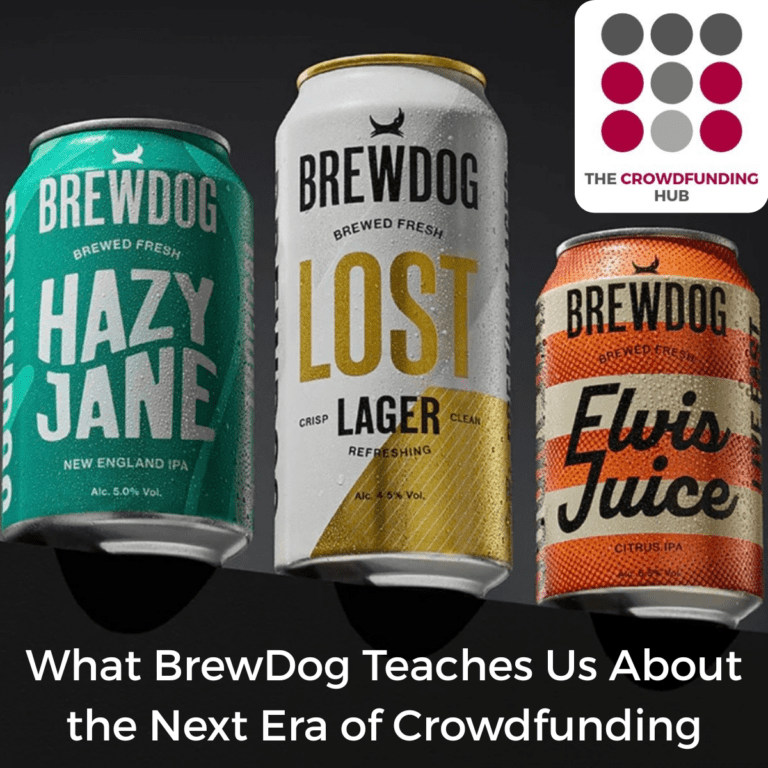
For many years, BrewDog was held up as the poster child for equity crowdfunding.
Through its Equity for Punks programme, the company raised tens of millions of pounds from over 200,000 supporters who believed in the brand and wanted to be part of its journey. Long before community investment became widely discussed, BrewDog demonstrated something powerful > people are willing to invest in companies they care about.
Customers became shareholders. Shareholders became advocates. And those advocates helped propel BrewDog from a small Scottish brewery into a global brand.
Recently, however, the story has become more complicated.
Following financial difficulties and restructuring, many early community investors have faced disappointing outcomes. Some observers now question whether crowdfunding is effective at scale. In my view, that would be the wrong conclusion. If anything, the BrewDog story highlights something much more important: crowdfunding is maturing, and the ecosystem must evolve alongside it.
The Power of Community Capital
Crowdfunding works because it taps into something often overlooked by traditional finance, the power of the community.
When people invest in a company they believe in, they don’t simply become passive shareholders. They become engaged participants in the story.
Over the last 12 years, I have often used this example when explaining the additional benefits of crowdfunding to founders. Imagine a shareholder going into a pub with friends and proudly saying, “I own this beer.” Suddenly the dynamic shifts, they buy the product, they recommend it, they bring friends back, they tell the story.
That kind of advocacy is extraordinarily powerful. It’s marketing that money alone cannot buy.
BrewDog understood this better than most in its early years. The Equity for Punks built a movement and raised capital at the same time, and that movement helped fuel the company’s growth.
When Community Capital Meets Institutional Capital
Where things become more complex is when companies move into their next phase of growth. Scaling a business often requires significant additional capital, the rocket fuel. Institutional investors, whether venture capital or private equity, bring experience, networks and the resources to accelerate expansion. But they also bring a different financial structure.
Institutional investment is typically built around preferred shares, liquidation preferences and defined return expectations. These structures are standard in the venture and private equity world, but they can create tension when layered on top of earlier community investment.
Crowdfunding investors, especially in Canada, the UK and Europe, often hold ordinary shares, which sit lower in the capital structure. In successful outcomes, this may not matter. But when challenges arise, the hierarchy of investors becomes very real.
This pattern isn’t exclusive to BrewDog; it’s just how venture finance typically operates. Crowdfunding didn’t fail, instead, it emphasises how crucial it is to bring together community support and institutional investment as companies grow.
The Importance of Governance and Communication
One of the most important elements in any crowdfunding campaign is trust.
Community investors understand that startups and growth companies are inherently risky. Businesses rarely follow a straight line. Markets shift, strategies evolve and unexpected events, such as a global pandemic, can change the trajectory of even the most promising companies.
What truly matters is open communication. Sharing regular updates, being transparent about challenges and having honest conversations about strategy all help investors feel like true insiders rather than outsiders. This approach fosters trust and strengthens relationships.
Crowdfunding investors often bring enormous goodwill to a company. Many of them are customers, advocates and long-term supporters. When founders maintain that relationship, the community can become one of the company’s greatest strategic assets.
Crowdfunding Is Still a Young Asset Class
It is worth remembering that equity crowdfunding, as we know it today, is still relatively young.
The regulatory frameworks, platforms and best practices that now exist did not exist when some of the earliest campaigns were launched. Companies like BrewDog were pioneers, experimenting with new ways of raising capital from their communities. They launched their campaign before the main platforms in the UK, Crowdcube and Seedrs (now Republic Europe), even existed. As the sector grows, so too does the sophistication of its structures.
Modern crowdfunding platforms now provide clearer disclosures, nominee structures that simplify governance, and better tools for managing large shareholder communities.
At the same time, founders are learning how to balance community ownership with the realities of scaling a business.
What the Next Era of Crowdfunding Looks Like
The next phase of crowdfunding will likely be defined by stronger alignment between founders, communities and later-stage investors.
We are already seeing signs of this evolution:
- clearer communication about investor rights and share structures
- more thoughtful governance models for large shareholder communities
- hybrid funding approaches that combine community investment with traditional capital
At its best, crowdfunding allows ordinary people to participate in the growth of companies they believe in. It broadens access to opportunities and strengthens the relationship between businesses and the communities that back them. That vision remains incredibly powerful.
The lesson from BrewDog is that the model did not fail; instead, it highlights that as crowdfunding expands, it must continue to evolve.
When founders recognise the strategic value of their investor communities and structure incentives to align all stakeholders, community capital can become one of the most powerful forces in modern entrepreneurship.
In the coming days, we’ll explore what these lessons mean for founders considering a community round and for investors looking to participate in the next generation of crowdfunding campaigns.